Potential Impacts of Regulatory Developments on the Business Models and Revenue Generation of Crypto Asset Service Providers for the Week Ending June 26, 2026

Executive Summary
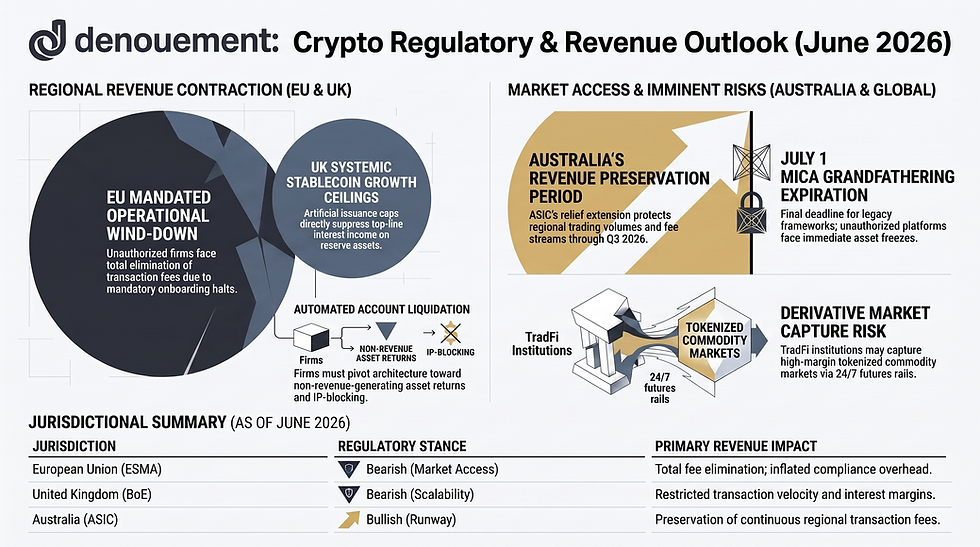
Bearish (Market Access): ESMA’s aggressive stance on post-MiCA transitions removes all ambiguity by mandating an immediate halt to marketing and onboarding for unauthorised firms, effectively forcing an expensive, non-revenue-generating operational exit from the EU market.
Bearish (Scalability): The Bank of England’s new regime for systemic stablecoins introduces artificial growth ceilings via strict issuance caps, restricting network effects and suppressing top-line volume potential for UK-targeted issuers.
Bullish (Operational Runway): Australia’s ASIC has extended its sector-wide no-action position through Q3 2026, expanding relief to umbrella and intermediary licensing models to preserve continuous regional revenue generation while formal licensing applications are finalised.
Deep Dive - The Signal
1. ESMA Mandates Hard Operational Wind-Down for Unauthorised CASPs (EU)
The Development: The European Securities and Markets Authority (ESMA) published explicit guidelines requiring unauthorised Crypto Asset Service Providers to immediately cease client onboarding and marketing, restricting activities to asset reallocation and position closures only.
The Business Impact: Platforms without formal MiCA authorisation cannot maintain a passive stance; they must immediately shut down regional onboarding gateways, deploy strict EU IP-blocking, and pivot their operational architecture entirely toward automated account liquidation and client asset returns.
The Revenue Reality: This forces a total elimination of transaction fees and custody revenues from the EU user base, while simultaneously inflating fixed compliance overhead as rigorous AML/CFT transaction monitoring must remain active throughout the non-revenue-generating exit phase.
2. Bank of England Limits Stablecoin Scale with Issuance Caps (UK)
The Development: The Bank of England finalised its regulatory framework for sterling-denominated systemic stablecoins, implementing temporary growth guardrails that cap maximum issuance levels per product.
The Business Impact: Issuers must fundamentally re-engineer their treasury management strategies to satisfy restrictive capital and reserve asset rules, while developing programmatic supply-control protocols to ensure compliance with the BoE’s growth ceilings.
The Revenue Reality: The artificial issuance ceiling directly restricts circulating supply and transaction velocity, severely depressing top-line interest income on reserve assets and payment-fee margins. At the same time, dual FCA/BoE oversight sharply increases ongoing structural compliance costs.
3. ASIC Extends No-Action Relief Protecting Intermediary Models (Australia)
The Development: ASIC extended its sector-wide no-action position for digital asset financial services to September 30, 2026, explicitly expanding the scope of relief to protect authorised representatives and intermediary arrangements.
The Business Impact: This operational grace period mitigates immediate enforcement risks for crypto platforms transitioning to the new Digital Asset Framework, allowing complex sub-licensee and umbrella models to remain intact while formal licensing tracks are completed.
The Revenue Reality: By averting an immediate regional operational halt, this extension preserves continuous Q3 2026 trading volumes and regional transaction fee streams, sparing firms the sunk costs of an abrupt market freeze.
Watchlist
July 1, 2026 – MiCA CASP Grandfathering Expiration (EU): The formal 18-month transitional runway for legacy national frameworks closes. Revenue Threat: Any unauthorised platform that is still actively matching trades or accepting deposits from EU citizens faces immediate regulatory asset freezes and compounding financial penalties, thereby terminating any remaining European trading fee revenues.
Mid-July 2026 – CFTC 24/7 Futures Public Comment Deadline (USA): The 30-day window for public input on transitioning standard commodity futures and perpetuals to continuous 24/7 digital rails closes. Revenue Threat: If legacy TradFi institutions successfully dictate these standards, they will capture the market structure for tokenised commodities, boxing crypto-native CASPs out of a high-margin derivative asset class.
#CryptoRegulation #MiCA #ESMA #CASP #BankOfEngland #BoE #Stablecoins #ASIC #DigitalAssets #CFTC #TradFi #CryptoCompliance #Tokenization #Fintech #FinancialRegulation #CryptoMarketStructure #EUCompliance #UKCrypto #APACFintech #RegulatoryRisk #DigitalEconomy #CryptoDerivatives #DeFi #InstitutionalCrypto


Comments